Artificial intelligence has the potential to raise productivity, living standards and long-run economic growth. But its benefits will not be automatic. In this column, originally published in Dagens Nyheter, I argue that the best policy response is not to slow technological progress through taxes and regulation, but to facilitate labour market adjustment, retraining and competition. The real challenge is to help people adapt to change—not to stand in the way of innovation.
Artificial intelligence has quickly gone from a vision of the future to an everyday tool. It’s already being used for writing, searching, programming, analyzing images, detecting fraud, and answering customer questions. The next step will be to integrate AI into an increasing number of businesses and public sector operations.
This raises understandable concerns. Will jobs disappear? Will shareholders take all the profits? Will a handful of tech companies dominate the economy? And does this mean tax policy needs to be fundamentally overhauled?
The answer is more nuanced than what is often heard in the debate. AI will likely transform the economy profoundly. But it will hardly spell the end of work. Nor does it justify panic-driven tax experiments. Instead, the role of policy should be to facilitate the spread of technology, make the labor market more flexible, and protect people during the transition.
The first point is simple but important: AI can increase our prosperity. When companies can produce more with the same resources, productivity rises. In the long run, this is the key source of higher wages, greater well-being, and increased tax revenue. The public sector, too, can become significantly more efficient, as AI frees up work time for tasks where human judgment and interaction are more important.
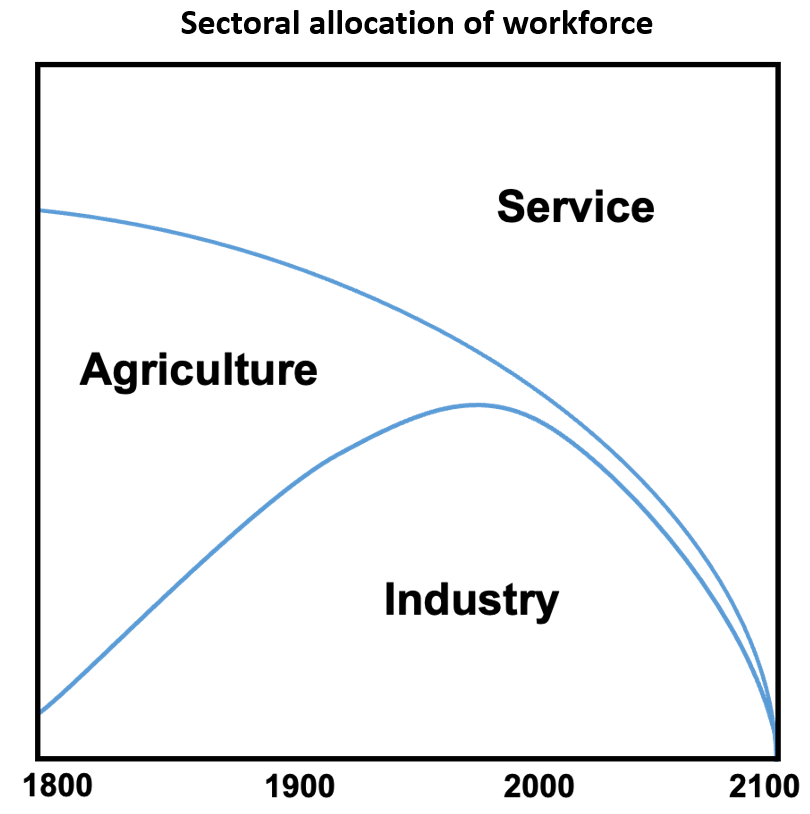
This does not mean that everyone wins at the same time. New technology always creates losers during the transition. Some jobs disappear, others change, and new ones emerge. But history contradicts the notion that machines will eventually render humans economically redundant. Industrialization replaced manual labor; computerization replaced many routine tasks, but work did not disappear. It simply shifted.
The same is likely to happen with AI. The more robots and AI systems we have, the cheaper they become. Consequently, the goods and services they help produce will also become cheaper. By the middle or end of the century, it is likely that machines will produce goods and food while humans work in the service sector: in care, education, machine maintenance, organization, and decision-making that requires trust.
Another common concern relates to the concentration of power. There is reason to be vigilant here, but not fatalistic. Today’s leading AI companies could become highly profitable. At the same time, recent years have shown how quickly the landscape is changing. Nvidia, OpenAI, and Anthropic have become key players in a short time. Open source makes it possible for more companies and countries to participate. New competitors are likely to emerge, not least from Asia.
What should concern us, however, is Europe’s weak position. High taxes, extensive regulations, and sluggish capital markets make it harder to build large technology companies here. If Europe becomes primarily a regulatory bystander, we will miss out on revenue, jobs, and influence.
What, then, will happen to inequality? It is far from certain that AI will widen wage gaps. Previous waves of computerization hit certain routine jobs hard and contributed to polarization in the labor market. But generative AI also affects highly educated professions: lawyers, economists, programmers, and analysts. At the same time, studies suggest that less experienced workers can benefit significantly from AI tools. The outcome is therefore not a foregone conclusion.
For this reason, policymakers should not base their approach on a worst-case scenario where the labor market collapses and capital takes over. Nor should they attempt to slow down technological progress in order to preserve today’s job structure. Such a policy would make us poorer and, in the long run, leave fewer resources for welfare and redistribution.
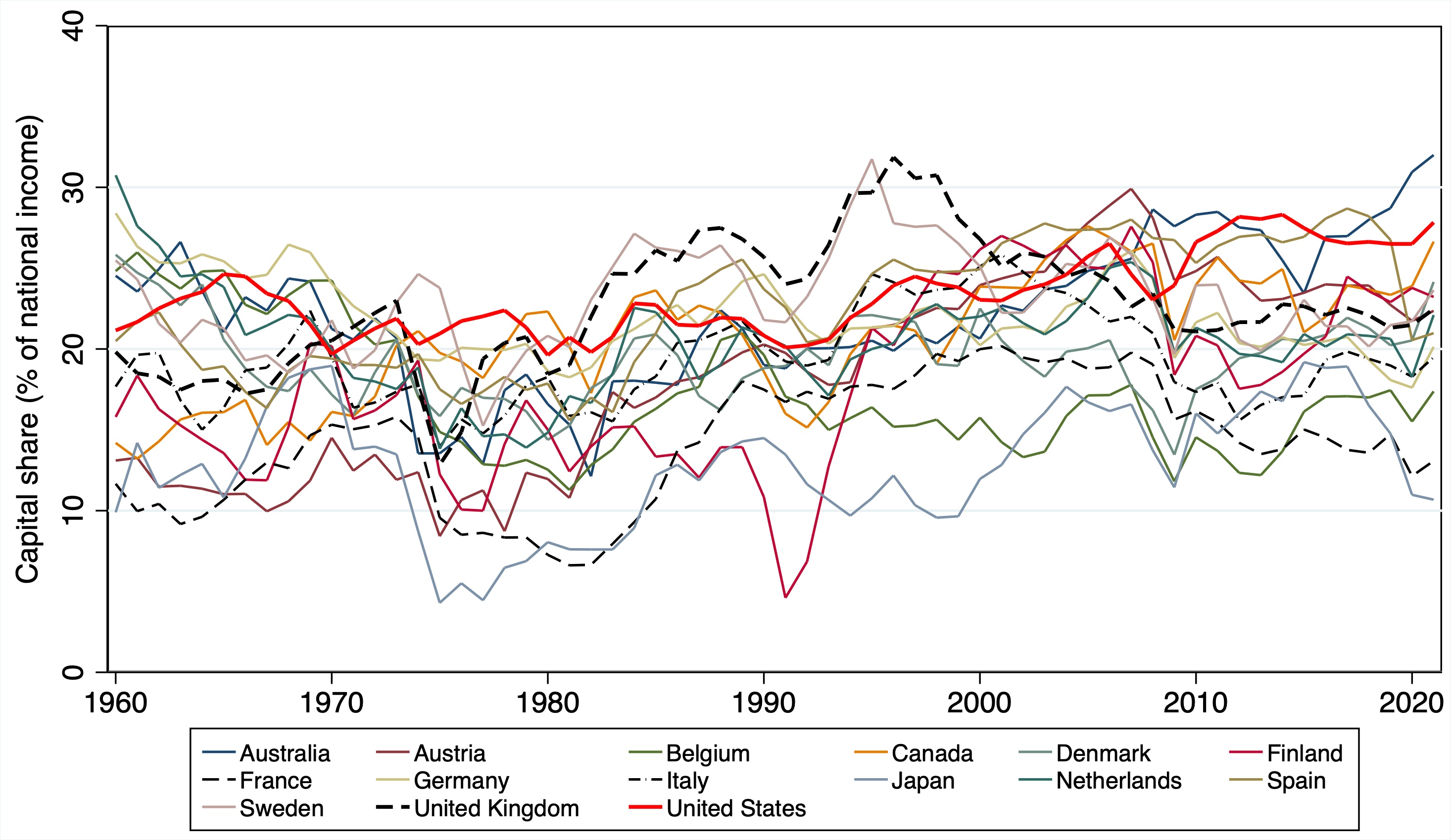
Taxes do not need to be changed dramatically either. If, in the long term, AI were to increase the share of capital income in national income, the balance between labor and capital taxes might need to be discussed. But there is still no clear empirical support for such a shift. The share of capital in OECD countries has hovered at the same level—around 20 percent —since the 1960s. Special “robot taxes” are a bad idea. What exactly is a robot? Moreover, a tax that targets investments in technology risks slowing the productivity growth we need.
Figure: Capital share of national income net of depreciation (Source: AMECO).
A better policy response is more down-to-earth. Europe and Sweden need labor markets where it is easier to move between jobs. Continuing education must work better—not as a slogan, but as practical pathways to new job roles. Competition policy must keep markets open, especially when data and platforms provide significant economies of scale. And the tax system should be broad, stable, and as non-distorting as possible.
However, social safety nets are needed more than ever. They do not hinder technological development; rather, they are a prerequisite for people to feel confident in embracing it. Unemployment insurance, support for workforce transition, and publicly funded welfare enable individuals to bear risks that would otherwise be too great. They also strengthen political support for openness and technological change.
The guiding principle should be to protect people, not specific jobs or companies. AI can generate significant economic gains if we allow the technology to develop and spread. But these gains must benefit many. This is best achieved through flexible labor markets, competition, quality education, and robust yet work-friendly social safety nets.
📖 Further reading: Bastani, S., Waldenström, D. (2024). ”AI, Automation, and Taxation”, in S Carcillo, S Scarpetta (eds.), Handbook on Labour Markets in Transition, London: Elgar.
 Ekonomistas
Mycket intressant, tänkvärt och nyanserat inlägg om både möjligheterna och hoten från AI.